
Every sales call, client interview, podcast recording, and team meeting your company holds contains useful information. Most of it disappears. People take partial notes, action items get missed, and the context from a high-value conversation is gone by the following week.
AI call transcription changes that. With the right tool in place, every recorded call becomes a searchable text document, a source of quotable content, and an input for your content and sales workflows.
For B2B marketing teams, the use cases go well beyond just having a record of what was said. Transcripts from podcast interviews fuel blog posts, social captions, newsletters, and show notes. Sales call transcripts inform content strategy by surfacing the exact language customers use. Customer interview recordings become quote libraries for case studies and testimonials.
This guide covers how AI call transcription works, which tools perform best for B2B use cases, and how to build a workflow that turns transcripts into real content assets.
Modern AI transcription tools use automatic speech recognition (ASR) models trained on large audio datasets. When you upload or connect a recording, the model segments the audio, identifies phonemes and words, and outputs a timestamped text file.
The best tools go further with speaker diarization: the ability to identify and label different speakers in a conversation. For an interview with two participants, this means the transcript is formatted as Speaker 1 and Speaker 2 (or by actual name, depending on the tool), rather than a single undifferentiated block of text.
Accuracy rates for modern AI transcription are high. Tools built on Whisper (OpenAI's open-source ASR model) or proprietary models like those used by Otter.ai, Fireflies.ai, and AssemblyAI typically achieve 85 to 95 percent accuracy on clear audio, with accuracy dropping in the presence of strong accents, heavy background noise, or highly technical vocabulary.
Post-processing is often applied after the raw transcription to improve punctuation, capitalization, filler word removal, and paragraph formatting. Some tools let you customize this; others apply it automatically.
Otter is one of the most widely used AI transcription tools in B2B contexts, largely because of its seamless integration with Zoom, Google Meet, and Microsoft Teams. It joins calls automatically as a bot participant, transcribes in real time, and generates a timestamped, speaker-labeled transcript that is available immediately after the call ends.
The interface allows in-transcript editing, comment threading, and searchable organization across all your recordings. For teams running frequent client calls or internal meetings, Otter's workflow integrations and real-time transcription are significant time-savers.
Accuracy is strong for clear audio with standard accents. Technical jargon and specialized vocabulary can cause errors, so a quick review pass is still worthwhile before sharing transcripts externally.
Fireflies is built specifically for revenue and GTM teams. It joins calls across Zoom, Teams, Meet, and Webex, captures transcripts with speaker labels, and then applies AI analysis on top: identifying action items, generating meeting summaries, flagging key topics, and tracking specific phrases across calls.
For B2B sales and marketing teams, Fireflies is particularly useful because it connects to CRM platforms like Salesforce and HubSpot, pushing call summaries directly into deal records. The content intelligence features, like tracking how often competitors are mentioned or how frequently certain objections come up, add real analytical value beyond basic transcription.
Descript takes a different approach: it is a full editing platform where the transcript and the audio are linked. Edit the text and the audio changes to match. This makes it especially powerful for podcast production, where you want to remove filler words, cut sections, or rearrange content by editing the transcript directly rather than working with audio waveforms.
For B2B podcast producers, Descript is one of the most efficient tools available. Transcription is built in, accuracy is solid, and the editing interface dramatically speeds up post-production compared to traditional DAW workflows.
AssemblyAI is a developer-focused transcription API with some of the best accuracy benchmarks in the industry for speech-to-text. It offers speaker diarization, sentiment analysis, topic detection, auto highlights, and content safety filtering as API-level features.
B2B teams with engineering resources can use AssemblyAI to build custom transcription workflows: automatically processing every recorded call, pushing transcripts to a content database, triggering show note generation, or feeding transcripts into a CRM. It is more setup than plug-and-play tools like Otter, but the customization and accuracy ceiling are higher.
Whisper is OpenAI's open-source ASR model, available for free via API or self-hosted deployment. Accuracy is excellent across a wide range of audio conditions and accents. It does not include native speaker diarization or real-time transcription, so it works best as a batch processing tool rather than a live meeting assistant.
Teams comfortable with Python and basic API usage can run Whisper on their own infrastructure at near-zero marginal cost, making it the most economical option for high-volume transcription workloads.
The operational value of AI transcription is clear: faster notes, better records, lower manual effort. But for B2B marketing teams, the strategic value is in what you do with the transcripts after they are generated.
Podcast show notes and summaries. Every podcast episode transcript is a ready-made input for show notes, chapter markers, and episode summaries. Rather than writing these from scratch, a producer can pull key quotes and moments directly from the transcript and organize them into a polished document.
Blog post sourcing. A 45-minute interview with a subject matter expert contains enough insight for multiple blog posts. The transcript lets you identify the strongest arguments, pull exact quotes, and structure content around the guest's actual language rather than a paraphrased summary.
Social and audiogram captions. Short clips cut from podcast episodes are most effective when paired with accurate captions. Transcripts provide the text for those captions, and the timestamps help your production team identify exactly which seconds of audio correspond to each quote.
Sales intelligence. Sales call transcripts reveal the objections, questions, and vocabulary that your prospects use most often. This is invaluable input for content strategy: if prospects consistently ask about a specific concern, that is a blog post, an FAQ, or a podcast topic waiting to be addressed.
Case study and testimonial sourcing. Customer interview recordings, once transcribed, become libraries of authentic client language. The best case study quotes are often things a client said naturally in a recorded conversation rather than something crafted for a formal testimonial.
For teams already producing podcast content, connecting transcription directly to the repurposing workflow is one of the highest-leverage operational improvements available. Tools like a podcast transcription service or the transcription features built into platforms like Descript make this connection much easier to maintain at scale.
For B2B teams evaluating AI call transcription tools, a few criteria matter most.
Accuracy on your specific audio. Test each tool with recordings that represent your typical call quality: your usual conferencing platform, your standard mic setup, any guests with strong accents or domain-specific vocabulary. Benchmark accuracy before committing.
Speaker diarization quality. For multi-participant calls, accurate speaker labeling is essential. A transcript that attributes quotes correctly is far more useful than one that mixes speakers randomly.
Integration with your existing stack. The best transcription tool is the one that fits into your existing workflow. If your team lives in Zoom and Slack, a tool that integrates natively saves more time than a standalone product with better accuracy.
Export formats. Make sure the tool exports in formats your downstream workflow can use: plain text, Word, SRT for captions, or JSON for programmatic processing.
Privacy and data handling. B2B calls often contain confidential information: deal terms, client concerns, strategic plans. Understand how your transcription provider stores, uses, and protects your audio and transcript data before enabling it on sensitive calls.
The teams that extract the most value from AI call transcription are not just using it reactively. They have a repeatable process.
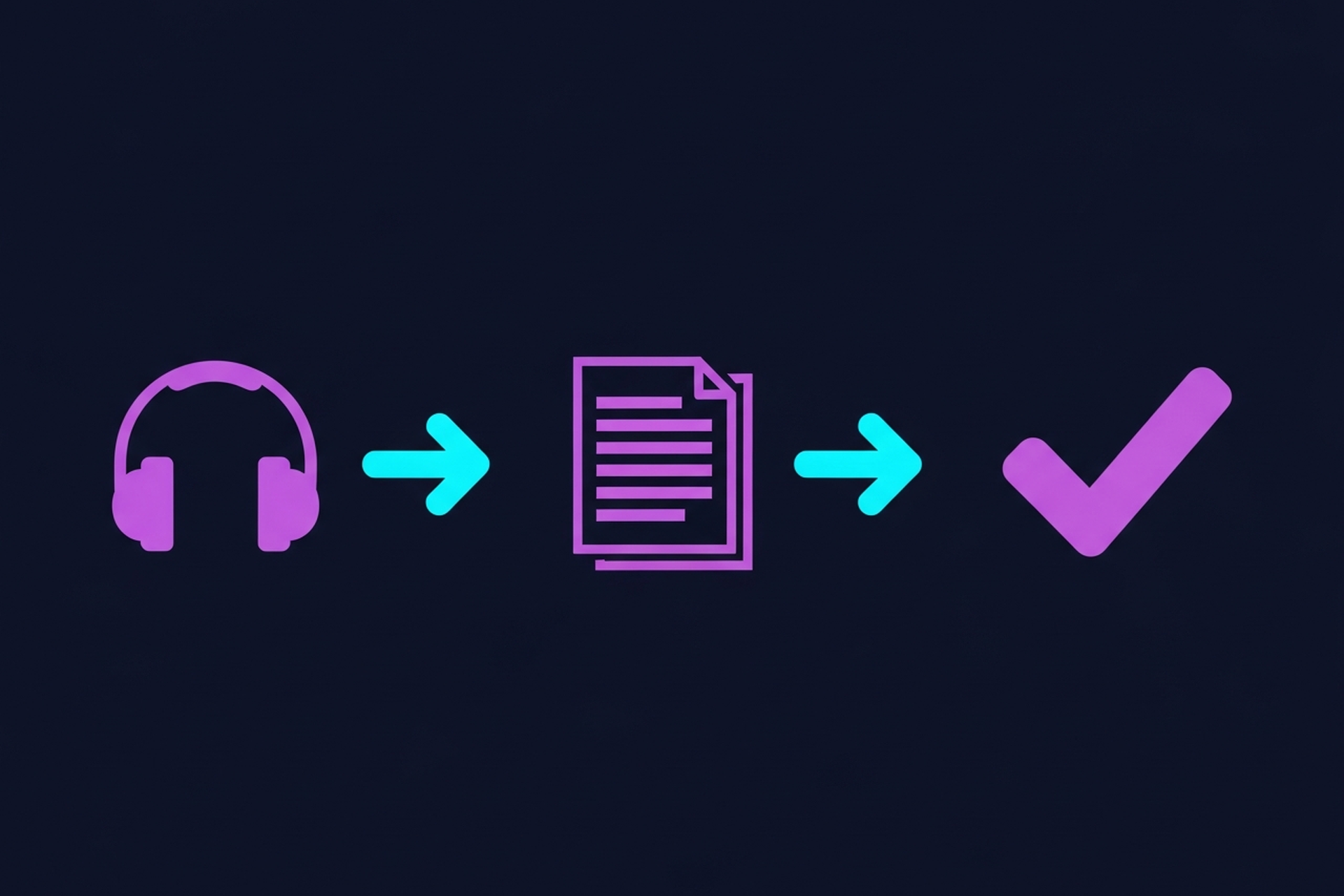
For podcast production, that process typically looks like this: record the episode, upload the audio to a transcription tool, review and clean the transcript, send it to a show notes writer, use timestamps to brief the clip editor, and archive the full transcript for future content sourcing.
For sales and marketing intelligence, the process is different: calls are transcribed automatically, summaries are pushed to the CRM, marketing reviews transcripts monthly to identify trending themes, and those themes feed directly into the editorial calendar.
Both workflows are achievable with current tools. The key is deciding on a process and executing it consistently rather than transcribing selectively or reviewing transcripts only when something specific comes up.
AI call transcription is one of the most practical productivity tools available to B2B content teams. It removes manual effort, preserves valuable information, and creates a foundation for a content repurposing pipeline that scales without proportional increases in headcount.
The technology is mature, the tools are accessible, and the workflow benefits are immediate. If your team is still manually writing notes from every recorded call, that is the most straightforward place to start.
Looking to build a full podcast and content repurposing workflow around your audio assets? Schedule a call with Podsicle Media and we will show you how done-for-you production and transcription-powered content strategies work together.