
Free video transcription tools have gotten genuinely useful. A few years ago, the output was barely salvageable. Today, some free tools produce transcripts accurate enough to use with light editing. That's a real change, and it matters for B2B content teams working with podcast episodes, webinar recordings, video interviews, and repurposed video content.
But "good enough to use with light editing" and "good enough to publish without review" are different things. Free tools have consistent weaknesses, and those weaknesses tend to cluster around exactly the type of content B2B marketers produce: technical vocabulary, multiple speakers, non-studio recording conditions, and industry-specific language.
This guide covers how free video transcription works, what tools are worth trying, where they fall short, and how to think about the tradeoff between cost and time when accuracy isn't where you need it to be.
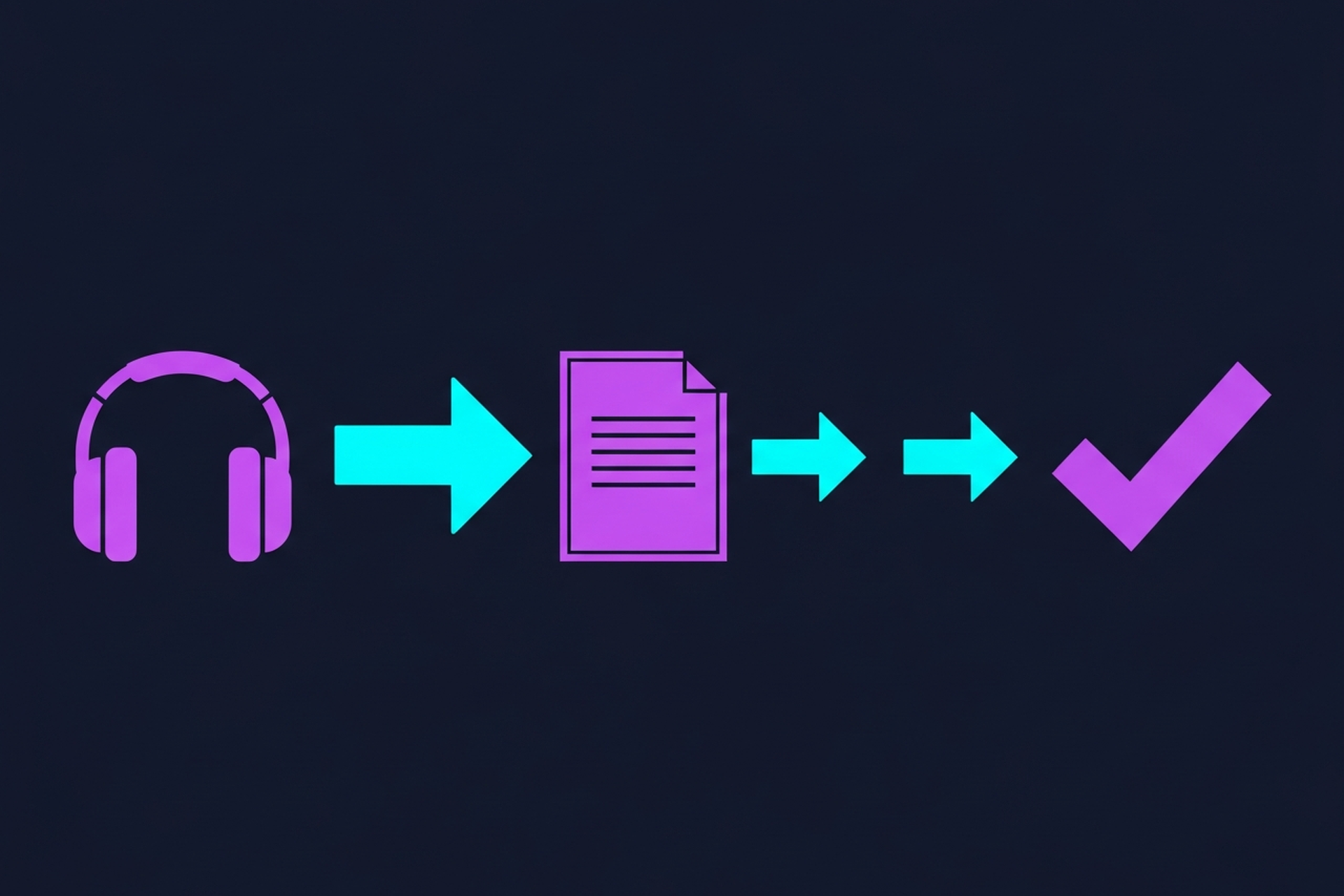
Most free video transcription tools use automatic speech recognition (ASR) powered by large language models. You upload a video file, the tool extracts the audio, and a model converts that audio to text. Output is usually available within minutes, even for longer files.
The accuracy of ASR systems has improved substantially with model improvements, but the underlying technology still has characteristic failure modes:
Free tools typically use general-purpose models without customization options. That's the main technical limitation, and it explains why they work well on casual speech and poorly on B2B interview content.
Several free video transcription options are legitimate starting points:
YouTube's auto-captions are generated for every video uploaded to the platform. Accuracy is variable but has improved. Useful for repurposing content you're already distributing on YouTube. Not usable as a final transcript without review.
Otter.ai (free tier) provides 300 minutes per month of AI transcription with speaker identification. Good interface, reasonable accuracy for conversational content. The free tier has export limitations that matter for professional workflows.
Whisper (OpenAI) is an open-source ASR model that can be run locally or via API. It's among the most accurate free options available, especially for clear audio. Requires some technical setup to use effectively, but teams comfortable with command-line tools will find it very capable.
Descript (free tier) allows limited transcription with a word-based editor that makes corrections quick. The free tier has project and export limits that make it better for evaluation than for production use.
Trint and Rev offer limited free credits rather than ongoing free tiers, which is useful for evaluation but not for sustained production.
The pattern that emerges with free transcription and B2B video content is consistent: accuracy is acceptable on easy audio and degrades rapidly when conditions get harder.
Podcast episode audio recorded over video calls (Zoom, Teams, Google Meet) often has compression artifacts, slight echo, and audio level variation between speakers. Free tools trained on studio-quality data handle this poorly.
Technical industry vocabulary is the biggest practical problem. A transcript that renders "SaaS" as "sauce," a guest's name as a common word, or your product name as something unrecognizable requires line-by-line review, not light editing. For a 45-minute episode, that's significant work.
Multi-speaker scenarios push diarization quality to its limits. Free tools often struggle to maintain consistent speaker labels when conversation pace is high or when speakers have similar vocal qualities.
Custom vocabulary support is rarely available at free tiers. This is the single feature that does the most to improve accuracy on technical content, and it's almost universally paywalled.
Free video transcription is not zero-cost. The cost is editor time. When a transcript requires heavy correction, the time spent reviewing and fixing it has a real dollar value.
A rough benchmark: an experienced editor can review and correct approximately 4-6 minutes of podcast audio per minute of editing time, working from a clean transcript. A poor-quality transcript that requires line-by-line correction can take 15-20 minutes of correction per minute of audio.
For a 30-minute episode, the difference between a clean transcript and a poor one can be 1.5-3 hours of editing time. At any reasonable hourly rate for a skilled content professional, that math quickly favors a paid transcription service with better accuracy.
The breakeven point depends on your volume, the complexity of your content, and the hourly cost of whoever does the editing. For teams running four or more episodes per month with technical content, the math usually favors paying for better accuracy.
Free transcription is appropriate when:
It's not the right call when accuracy matters, volume is significant, or your team's time is better spent on higher-value work than correcting transcription errors.
For B2B podcast and video content, the workflow that makes sense in most cases: use free tools for evaluation and for low-stakes content, move to paid automated transcription for regular production volume, and reserve human-reviewed transcription for your highest-value content.
Paid automated transcription from services like Riverside.fm, Descript Pro, or dedicated transcription services typically runs $0.10-$0.25 per minute and produces materially better results on technical content. For an average 35-minute episode, that's $3.50-$8.75 per transcript, a small line item in a production budget.
If you're building a systematic podcast content operation, transcription should be a defined step in your production workflow, not something you figure out per episode. For context on how transcription fits into a complete repurposing pipeline, see our breakdown of transcription services and our B2B podcast content strategy guide.
If you are going to use free transcription, there are ways to improve the output before it becomes a correction problem.
Improve your source audio first. A higher-quality recording reduces the error rate across any transcription tool. Before worrying about which free service to use, fix the recording end: a dedicated USB microphone, headphones to prevent feedback, and a quiet recording environment will do more for transcript accuracy than any tool choice.
Provide context where possible. Some free tools accept a prompt or instructions before processing. Listing key names, company names, and technical terms that are likely to appear helps the model handle them correctly.
Use timestamps strategically. Rather than reviewing a transcript word-by-word, scan the timestamped output and jump to the audio at points where the text looks wrong. This is faster than linear review and focuses your correction time on actual problems.
Fix the custom vocabulary issue. Several free tools don't allow custom vocabulary lists on their free tier, but you can compensate by doing a find-and-replace pass on your most commonly mangled terms after the initial transcript is generated. Build a short glossary of how your tool consistently misrenders your industry terms and correct them in batch.
These approaches help, but they have limits. Genuinely poor audio quality or technically dense content will still produce results that require significant correction time. The ceiling on free transcription accuracy is set by the model and the audio quality, not by how cleverly you use the tool.
Transcription accuracy isn't just a production detail. When your transcript is the source material for a blog post, show notes, social clips, or email content, errors in the transcript propagate into every downstream asset. A wrong company name, a misquoted statistic, or a garbled insight from a guest reflects on your brand in the content that readers actually see.
That's why treating transcription as a pure cost item to minimize misses the point. It's a quality control step in your content pipeline, and the standard you hold it to should match the standard you hold the rest of your content to.
If you're looking for a production setup that handles transcription as part of a complete workflow, schedule a call with Podsicle Media or get your free podcasting plan and see how we build this into the production process from day one.