
You have the royalty-free track. You have the podcast episode. Now you need the two to work together. That means editing the music to fit your show format, not the other way around.
This guide answers the question directly: how can you edit music for your B2B podcast without spending hours learning audio engineering? We will cover the tools, the process, and the decisions that make the biggest difference in how your show sounds.
When B2B content teams ask how to edit music, they are usually solving one or more of these problems:
Each of these tasks is straightforward once you know the tool you are using. None of them require a music production background.
The tool you choose depends on three things: your budget, your team's existing software, and how much music editing volume you actually have.
Audacity is the most accessible starting point. It runs on Mac, Windows, and Linux. You can import WAV or MP3 files, make precise cuts, apply fades, normalize volume, and export finished clips. The interface is dated but functional. For teams doing occasional music edits, Audacity covers the basics without cost.
GarageBand is the Mac-only free option that offers a cleaner interface and non-destructive editing. You can work on your music clip without affecting the original file. GarageBand also supports automation, which means you can program volume ramps over time rather than applying a single fade.
Adobe Audition is the professional standard for podcast editing environments. Its music editing capabilities include multitrack view, spectral frequency display for removing artifacts, and batch processing. For teams managing 10 or more episodes per month, the time savings are significant.
Descript handles music editing inside the same workspace you use for transcript-based voice editing. If you are already using Descript for your podcast workflow, editing music clips within the same project reduces context switching.
Logic Pro is another Mac option worth mentioning for teams that produce video content alongside their podcast. It handles music editing with precision and integrates with Final Cut Pro for video workflows.
For a broader comparison of editing tools and how they stack up for B2B podcast production specifically, our guide on best voice editing software covers the full picture.
Before editing anything, confirm your music is properly licensed. Royalty-free does not always mean license-free. Check whether your license covers commercial use and podcast distribution. Platforms like Epidemic Sound, Artlist, and Musicbed provide clear licensing for B2B use cases.
Download in WAV format when available. WAV preserves quality through the editing process. You convert to MP3 on the final export.
Open your editing tool and import the track. In Audacity, go to File > Import > Audio. In GarageBand, drag the file into a new track. In Audition, open the file in the Waveform Editor.
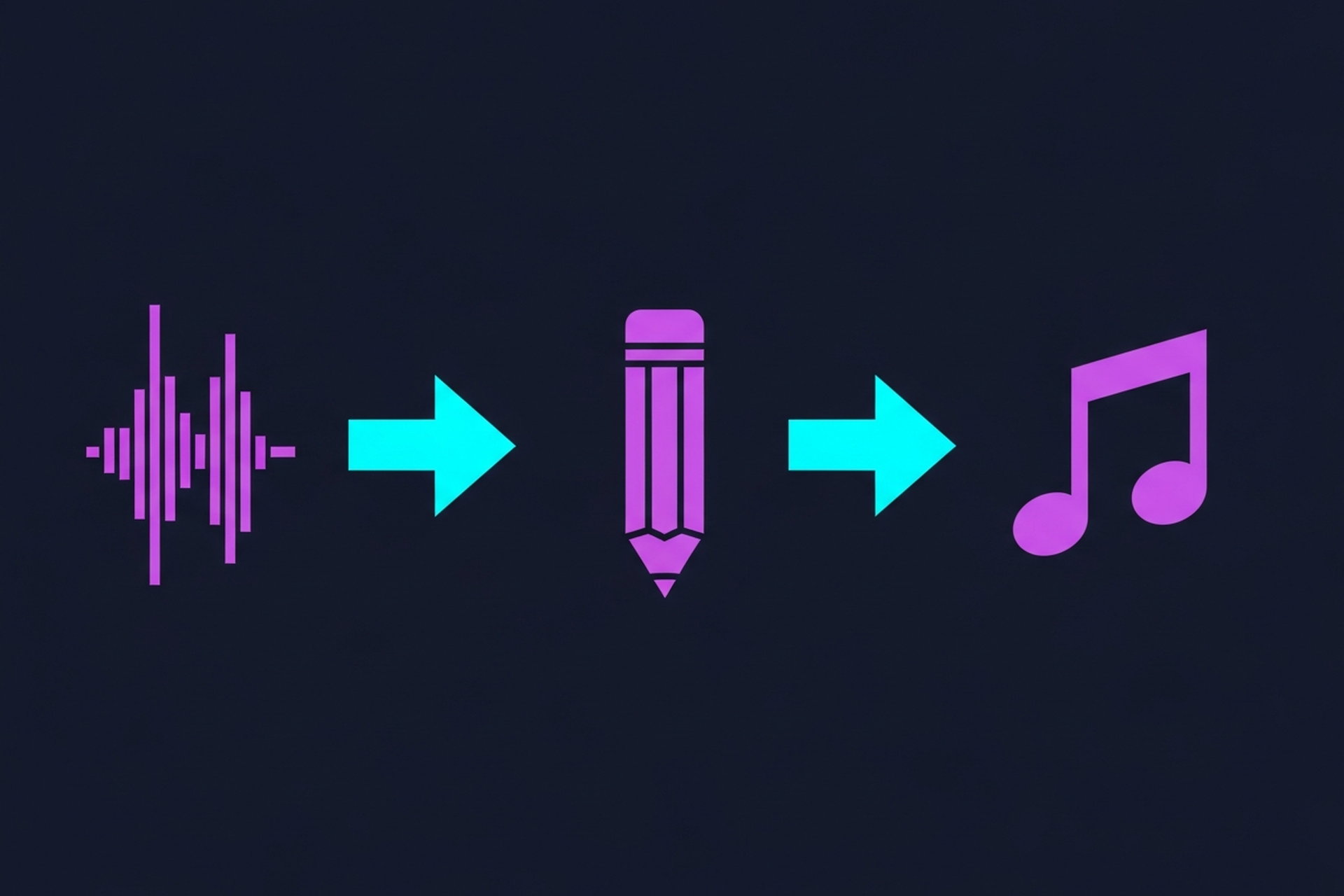
You will see the waveform appear as a visual representation of the audio. Louder sections show taller peaks. Quiet sections are flatter.
Decide how long your music needs to be. For podcast intros, 6 to 10 seconds is the standard range. Outros typically run 15 to 30 seconds. Transition stings are usually 2 to 4 seconds.
Use your editor's selection tool to highlight the portion you want to keep. Then delete everything outside that selection. Work from the natural structure of the track. Cuts at beat boundaries sound intentional. Cuts in the middle of phrases sound like mistakes.
Select the first 0.2 to 0.5 seconds of your clip and apply a fade-in. This prevents the audio from starting at full volume, which sounds harsh.
Select the last 1 to 3 seconds of your clip and apply a fade-out. The length depends on the feel you want. A 1-second fade is crisp. A 3-second fade is more gradual and cinematic. For B2B podcasts, 1.5 to 2 seconds usually hits the right balance.
Every major editing tool has built-in fade controls. In Audacity, use Effect > Fade In and Fade Out. In Audition, drag the fade handles at the edges of the clip in the multitrack view.
Music should support the voice track, not compete with it. A general starting point is setting your music to -20 dB to -25 dB when speaking begins, and letting it sit louder (around -12 dB to -15 dB) for the section before the host speaks.
This is called ducking, and it can be done manually or automatically with automation. In Audition, you can use the Essential Sound panel to apply automatic ducking. In Audacity, you do it by adjusting the volume envelope manually.
Export as MP3 at 192 kbps and 44.1 kHz. Name the file clearly. Use a naming convention like show-intro-v1.mp3 so you can track versions and swap in updates without confusion.
Keep the original WAV file archived. You will want it if you need a different length version later or if a file gets corrupted.
The most common music editing mistake in B2B podcast production is volume balance. Music that is too loud drowns out the host. Music that is too quiet sounds like an afterthought.
Use your editing tool's meters to check levels. When the host is speaking, the music should be barely audible in the background, sitting 15 to 20 dB below the voice track. If you have to consciously notice the music while the host is talking, it is too loud.
A simple test: play your episode through earbuds while doing something else. If you catch yourself distracted by the music, it needs to come down.
Sometimes you need a clip to run longer than the original track supports. Looping lets you extend a section by seamlessly connecting the end of a phrase back to the beginning.
Finding a good loop point requires listening carefully for a spot where the track resolves naturally. This is typically at the end of a musical phrase, just before the next phrase begins. The waveforms on either side of the loop point should have similar amplitude and energy.
Once you have identified the point, use crossfade to blend the join. A 0.1 to 0.3 second crossfade hides the transition effectively. Most editors handle this with a built-in crossfade tool.
For B2B podcasts, looping is most useful for intro sections that run longer than your stock clip supports. Interview shows with extended introductions sometimes need 20 or 30 seconds of music, which requires either a looped clip or a longer source track.
Edited music clips become part of a repeatable production workflow. Once you have your intro, outro, and transition clips finalized, you should rarely need to re-edit them.
The goal is a system where your editors are dropping pre-approved clips into position, adjusting levels if needed, and moving on. This keeps production time predictable.
For teams building this workflow from scratch, understanding what a complete podcast production services setup looks like is useful context. You can see which pieces you want to handle in-house and which are worth outsourcing.
Knowing how to edit music files is valuable. But at some point, the question shifts from "how do I do this" to "should I be doing this myself."
For marketing directors managing branded podcast programs, the answer often comes down to volume and consistency. If your show publishes weekly, music editing is one of dozens of production tasks that add up. Done-for-you podcast production handles all of it, including music licensing, clip preparation, level matching, and final QA.
Professional podcast production services deliver consistent audio quality across every episode without your team spending time on the technical details. That matters for B2B brands where the show is a marketing asset, not a personal project.
If you want to explore what fully managed production looks like for your show, contact Podsicle Media. We produce B2B podcasts end-to-end, including all the music work.
| Use Case | Recommended Length | Fade In | Fade Out | Export Bitrate |
|---|---|---|---|---|
| Intro | 6 to 10 seconds | 0.3 seconds | 1.5 seconds | 192 kbps |
| Outro | 15 to 30 seconds | 0.5 seconds | 3 seconds | 192 kbps |
| Transition sting | 2 to 4 seconds | 0.1 seconds | 0.5 seconds | 192 kbps |
| Background music | Variable | 1 second | 2 seconds | 192 kbps |
These are starting points. Adjust based on your show's tone and pacing.
Editing music for your B2B podcast comes down to four core skills: trimming to the right length, applying clean fades, matching levels to your voice track, and exporting at the right settings.
Free tools like Audacity and GarageBand handle this well for low-volume needs. Paid tools like Adobe Audition scale up for teams producing consistently.
Build a small clip library once, maintain it as your show evolves, and let it run as a stable piece of your production process. That is how you get professional-sounding audio without rebuilding from scratch every episode.