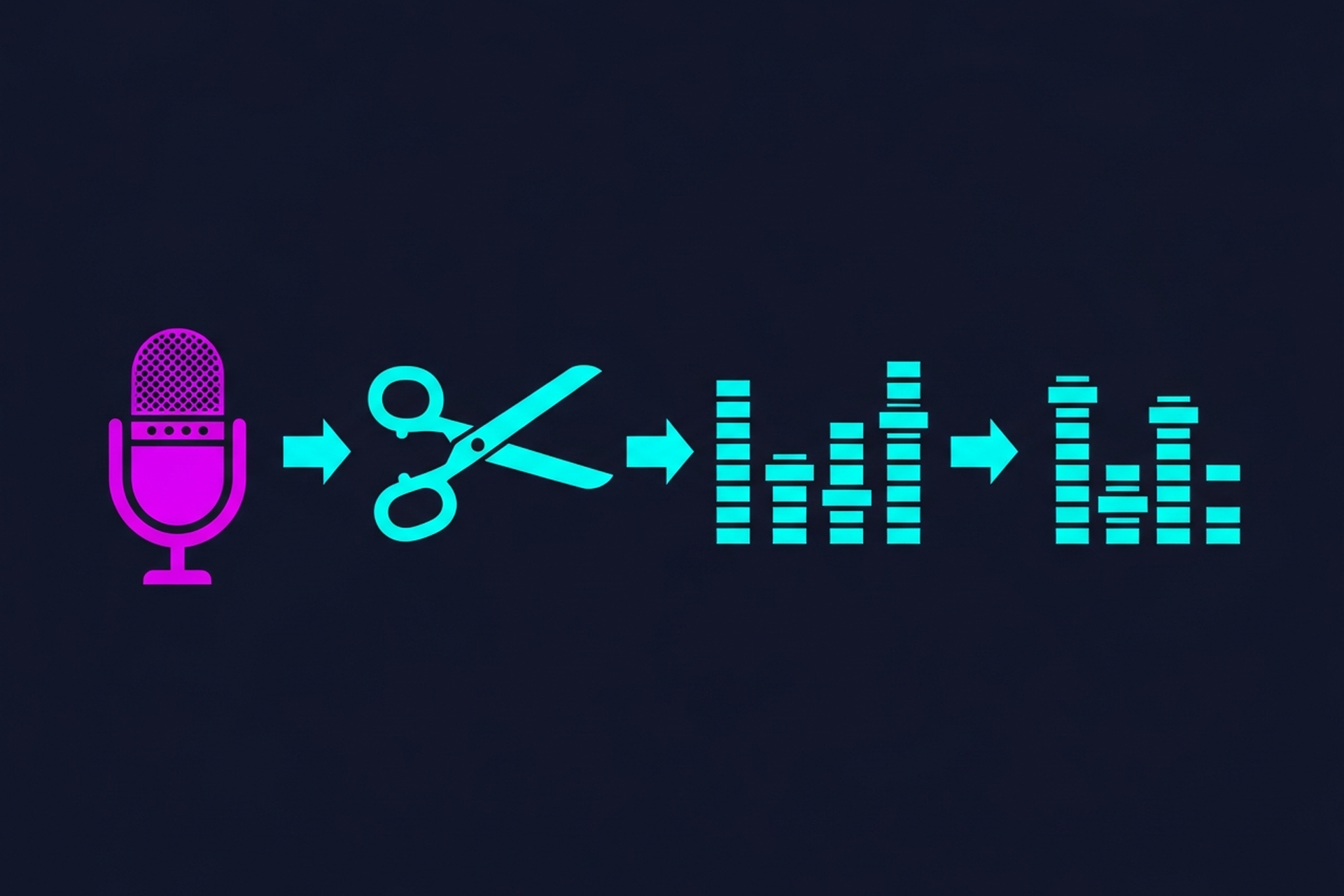

Editing podcast audio is where most B2B teams underestimate both the time required and the impact on listener experience. A poorly edited episode, one with uneven levels, background noise, long dead silences, or jarring transitions, communicates something about your brand whether you intend it to or not.
This guide walks through the complete podcast audio editing process step by step: the tools, the order of operations, the specific techniques that matter, and a realistic assessment of when it makes more sense to outsource this work than to handle it in-house.
Good editing starts before you touch the audio. Two prerequisites:
Organized, properly named files. After each recording session, name your files consistently: host audio, guest audio, any additional tracks. A naming convention like episode-047-host.wav and episode-047-guest.wav saves confusion when you are managing a high volume of episodes.
Editing software. The choice matters less than developing proficiency with one tool. Common options used by professional producers include Adobe Audition, Logic Pro, Reaper, and GarageBand. Each has a different learning curve and price point. For a detailed breakdown, see our comparison of audio recording programs and which setups are best suited for different production workflows.
Do not start editing directly on your original files. Always work on copies. If you make an irreversible mistake, you need the ability to start over from clean source files.
Before making any edits, listen through the entire recording once and make notes. Mark timestamps for:
This review pass prevents you from editing blindly and discovering 20 minutes in that you need to restructure the episode entirely. The review also helps you understand the flow of the conversation before you start removing pieces of it.
For interview-format B2B podcasts, pay particular attention to the opening five minutes. If the conversation takes a while to get started, consider whether you can trim the preamble to open with a stronger hook.
If you recorded remotely with a tool like Riverside.fm or SquadCast, you will have separate audio tracks for the host and each guest. If you recorded locally with multiple microphones, same situation.
Sync all tracks to a common start point. The easiest approach is to have all participants clap once at the start of recording: the clap creates a visible spike in every track that makes alignment easy.
Once synced, check that the tracks are properly aligned by selecting a section where both speakers are audible and confirming there is no echo or doubling effect.
Before any processing, do your structural editing. This means:
Cut the obvious removals. Technical failures, false starts, "can you hear me" exchanges at the start of remote recordings, and any content that should not be in the final episode. Do these cuts first so you are not processing audio you are going to remove anyway.
Remove pre-episode and post-episode recordings. The few minutes before the guest joins and after the conversation ends should be cut.
Trim to your target episode length. If your show format is 25 to 35 minutes and your raw recording is 55 minutes, this is the stage where you make decisions about what to cut to reach your target length.
Do your structural editing before any noise reduction or processing. Processing a 55-minute file takes longer than processing a 30-minute file, and there is no point processing audio you plan to delete.
With the structure in place, work on each track separately before mixing:
Noise reduction. Every recording contains some background noise: room hum, HVAC systems, computer fans, ambient sound. Most DAW software includes a noise reduction plugin. The process is: sample a section of silence to create a noise profile, then apply reduction to the full track. Be conservative with the reduction amount. Over-processing creates a metallic artifact quality that is worse than mild background noise.
Clip removal. Loud clipping sounds (accidental bangs, pops, mic handling noise) appear as sharp visual spikes in your waveform. Find them visually, listen to confirm, and use your DAW's repair tools to reduce or remove them.
De-clicking and de-popping. Mouth sounds, microphone pops on plosives ("p" and "b" sounds), and other artifacts can be reduced with a de-clicker plugin or careful manual editing. These are particularly noticeable in close-microphone recordings.
Remove filler words. This is the most time-consuming editing task. "Um," "uh," "like," and extended pauses should be reduced, not necessarily eliminated. A completely filler-free conversation sounds unnatural. Aim for reduction to a level that does not draw attention.
For context on professional tools used for this work, see our overview of best voice editing software and how they compare for podcast-specific workflows.
Remote recordings almost always have level inconsistencies between speakers. One person's audio might peak at -6dB while another's peaks at -18dB. The listening experience will be jarring if you do not address this.
Set gain appropriately on each track. The target is to have all speakers at roughly comparable loudness levels, with peaks around -12dB to -6dB on individual tracks before any processing.
Apply compression per track. Compression reduces the dynamic range of each track, pulling down the loudest moments and pulling up the quietest. This creates more consistent, listenable audio. Start with a modest ratio (2:1 or 3:1) and adjust by ear. Over-compressed audio sounds flat and lifeless.
Check transitions. Listen specifically to moments where the host and guest trade speaking turns. Level inconsistencies are most noticeable at these handoffs.
With individual tracks cleaned and balanced, bring them together:
Set the overall mix level. All tracks combined should peak around -6dB before mastering, giving you headroom for the final limiting stage.
Handle crosstalk. When both speakers talk simultaneously, the mixed audio gets muddy. You can reduce this by temporarily ducking (lowering the level of) the non-primary speaker during these moments.
Add music elements. If you have an intro, outro, or transition music, add it at this stage. Music should not compete with the spoken content in level. Typical practice is to bring music in at full volume, then fade it under the voice when the host begins speaking.
Mastering is the final processing stage that prepares your audio for distribution. The key steps:
Final EQ. A gentle high-pass filter below 80Hz removes any remaining low-frequency rumble. A slight boost around 3kHz to 5kHz adds clarity to voice.
Limiting. A limiter prevents your audio from exceeding a ceiling level. Set the ceiling to -1dBFS to prevent clipping on any platform.
Loudness normalization. Both Apple Podcasts and Spotify apply loudness normalization to all episodes. The target integrated loudness for podcasts is -14 LUFS (Loudness Units relative to Full Scale). Use a loudness meter plugin (free options include Youlean Loudness Meter) to measure your episode and adjust your limiter output gain until you hit the target.
Export as 44.1kHz, 16-bit, stereo MP3 at 128kbps or higher. This format is compatible with all podcast hosting platforms and keeps file sizes manageable.
Never publish an episode without a final quality control pass:
Listen on earbuds and speakers. Different playback devices reveal different problems. Something that sounds fine on studio monitors may have issues on consumer earbuds.
Check the beginning and end. Awkward starts and abrupt endings are common editing errors.
Verify the runtime matches your expectations. A 30-minute episode that somehow exports as 28 or 33 minutes indicates something went wrong in your editing session.
Check levels on your phone. Listen at normal phone speaker volume. If you need to turn your phone to maximum to hear it comfortably, your levels are too low.
Be honest with yourself about what this work requires:
Basic editing (structural cuts only, minimal processing): 1 to 2 hours for a 30-minute episode
Standard professional editing (full process as described above): 3 to 5 hours for a 30-minute episode
High-quality editing with transcript-level filler word removal: 5 to 8 hours for a 30-minute episode
For a team publishing one episode per week, that is 3 to 8 hours per week committed to editing alone, before accounting for show notes, distribution, and content repurposing.
Editing podcast audio is a learnable skill, but it is also a time sink that may not represent the best use of your marketing team's capacity.
Outsource audio editing when:
Keep editing in-house when:
The economics usually favor outsourcing for B2B teams publishing weekly. The time cost of in-house editing at employee compensation rates typically exceeds the cost of a professional production service. For a full comparison, see our breakdown of podcast production services and what professional audio editing support typically includes.
Knowing how to edit podcast audio is useful even if you outsource the work. You understand the process, you can evaluate quality, and you can give informed feedback to your production partner. But if editing is taking time away from higher-leverage work, that is a problem with a direct solution.
At Podsicle Media, we handle full post-production for B2B podcast programs, including editing, mastering, show notes, and distribution. Talk to us about what a done-for-you production program looks like.