
A podcast transcript is one of the most useful assets your show can produce. It makes your content accessible to deaf and hard-of-hearing listeners, searchable by Google, and usable as raw material for blog posts, newsletters, social clips, and show notes. The question most podcast teams have is not whether to transcribe. It is how.
There are three main ways to get podcast transcripts in 2026, and the right choice depends on your volume, budget, accuracy requirements, and how the transcript fits into your broader content workflow. This guide walks through each method, covers the tools worth using, and shows you exactly how to get a transcript from your next episode.
Before getting into the how, a quick case for the why.
SEO value. Search engines cannot index audio. A detailed podcast transcript gives Google something to crawl and rank. For B2B companies, this means the expert insights your guest shares in episode 42 can start driving organic search traffic once you publish the transcript.
Accessibility. Making your content available in text form opens it to a broader audience: listeners who are deaf or hard of hearing, people in noisy environments who cannot play audio, and anyone who prefers to read over listen.
Content repurposing. A transcript is the starting point for turning one episode into ten pieces of content. Blog posts, show notes, LinkedIn posts, email newsletters, and quote graphics all start from the same transcript. Without a clean transcript, every repurposing task requires someone to manually re-listen, which is slow and expensive.
Internal knowledge. For shows that interview customers, partners, or industry experts, transcripts create a searchable archive of institutional knowledge. You can quickly retrieve what your guest said about pricing, implementation challenges, or market trends three seasons ago.
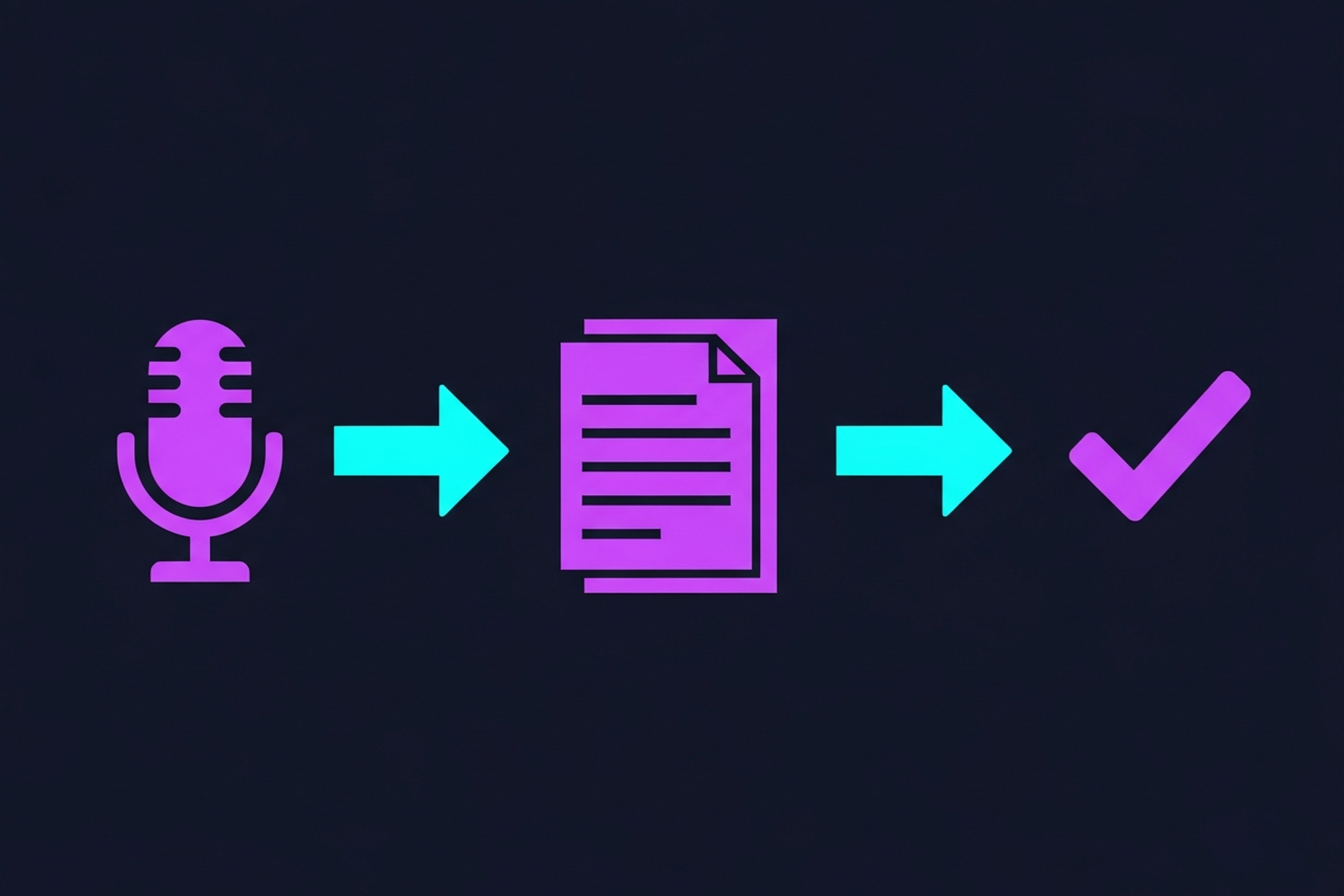
AI-powered transcription is the most common approach for podcast teams. It is fast, affordable, and accurate enough for most use cases.
You upload your audio or video file to the tool, or in some cases you record directly within the platform. The tool processes the audio using a speech recognition model and returns a timestamped text transcript, typically within minutes.
Most AI tools also offer speaker diarization, which labels different speakers in the transcript. This matters for interview-format podcasts where you need to distinguish the host from the guest.
Descript is the most popular choice for podcast teams because it combines transcription with editing. You can edit the audio by editing the text, which makes cleanup and clipping significantly faster. Descript's transcription accuracy is strong on clean audio.
Otter.ai is widely used for meetings and interviews. It offers real-time transcription for live recordings and works well for team-based workflows where multiple people need access to transcripts.
Riverside.fm includes transcription as part of its recording platform. If you record remotely, Riverside handles both the recording quality and the transcript in one step, which eliminates a workflow step.
Whisper (OpenAI's open-source model) is available through several third-party tools and directly via API. It is highly accurate and free to use if you have technical resources to set it up. Several browser-based tools and CMS integrations are built on Whisper.
Podcastle and Castmagic are podcast-specific tools that combine transcription with content generation. They will transcribe your episode and then use that transcript to generate show notes, social posts, and blog outlines automatically.
Expect to spend 10 to 20 minutes on review and cleanup for a typical 45-minute episode. Longer episodes, more speakers, and lower audio quality all increase cleanup time.
AI transcription accuracy for clean audio with clear speech from native English speakers typically runs 95 to 99 percent. That means 1 to 5 errors per 100 words, most of which will be minor word substitutions or punctuation issues.
Accuracy drops with:
For podcasts with guests from non-English-speaking countries or heavy use of industry-specific vocabulary, budget more time for cleanup.
Several major podcast hosting platforms include automatic transcription as part of their feature set. This is the simplest option if you are already using one of these platforms.
Spotify for Podcasters (formerly Anchor) provides automatic transcription for episodes. The transcript is used to power Spotify's in-app search and can be downloaded for your own use.
Buzzsprout offers an optional transcription add-on that generates a transcript shortly after upload and displays it on the episode page, which adds SEO value to your show website.
Podbean includes transcription in its Patron subscription tier.
Transistor provides a transcription feature that produces a downloadable transcript and embeds it in the episode page.
The main advantage of platform transcription is automation: you do not need a separate workflow step. The limitation is that accuracy is typically lower than dedicated transcription tools, and you have less control over the output format.
Platform transcription is a good fit if you want a hands-off approach and do not have a high bar for transcript quality. For teams using the transcript only for accessibility and basic show notes, it works well. For teams doing serious content repurposing or using the transcript as the foundation for blog posts, a dedicated transcription tool usually produces better results.
Human transcription involves sending your audio file to a service that assigns a trained transcriptionist to produce the text. Accuracy is the primary reason to use this method.
Rev is the most widely used professional transcription service. It offers a standard turnaround of 24 hours and expedited options for faster delivery. Accuracy is guaranteed at 99 percent.
Scribie is a more affordable option with 98 percent guaranteed accuracy. Good for teams doing moderate volume who want human accuracy without paying Rev's premium.
TranscribeMe offers tiered services from automated to full human review, which lets you choose your accuracy and price point. They also specialize in academic and research use cases, which makes them a good choice for interview-heavy shows.
Human transcription for a 45-minute episode typically costs $45 to $135 depending on the service and turnaround speed.
For most B2B podcast teams doing weekly episodes, human transcription at $45 to $135 per episode adds up quickly. The economics work in specific situations:
For standard weekly episodes with good audio quality and clear speakers, AI transcription with a human review pass is typically the better value.
If you have a back catalog of episodes without transcripts, you have the same three options. For large back catalogs, AI transcription is almost always the right starting point because of cost. Transcribing 100 episodes at $1.50 per audio minute on a human service would cost thousands of dollars. The same batch through an AI tool might cost under $100 depending on your subscription.
For back catalog projects, some AI transcription tools offer bulk upload features that let you process multiple files simultaneously. Whisper-based tools are particularly cost-effective for large batches.
A transcript is only as valuable as what you do with it. For B2B podcast teams, the highest-value uses are:
Show notes: A structured summary of the episode with key takeaways, timestamps, and links mentioned. See how to get the most from this step in our guide to podcast transcript generators.
Blog posts: A 1,200 to 1,800 word article built from the episode's core insights. The transcript gives you the raw material; see the podcast to blog conversion guide for the full workflow.
Social clips: Pull the three to five most quotable moments from the transcript and turn them into LinkedIn posts, Twitter threads, or quote graphics.
Email newsletter content: Use the transcript to write a concise episode summary for your email list. This drives episode listens and keeps your list engaged.
The investment in getting good transcripts pays dividends across every piece of content you produce from your show.
Ready to build a podcast production and repurposing workflow that actually scales? Talk to Podsicle Media about our done-for-you service.