Most people think "company podcast" means an external show you use to build an audience. But there's a second type that more organizations are quietly deploying in 2026: internal company podcasts. These are private audio channels built for your employees, not the public. And they're changing how teams communicate, train, and connect at scale.
If your company has remote teams, high turnover, or a comms strategy that relies too heavily on all-hands meetings and long email threads, this format deserves your attention.
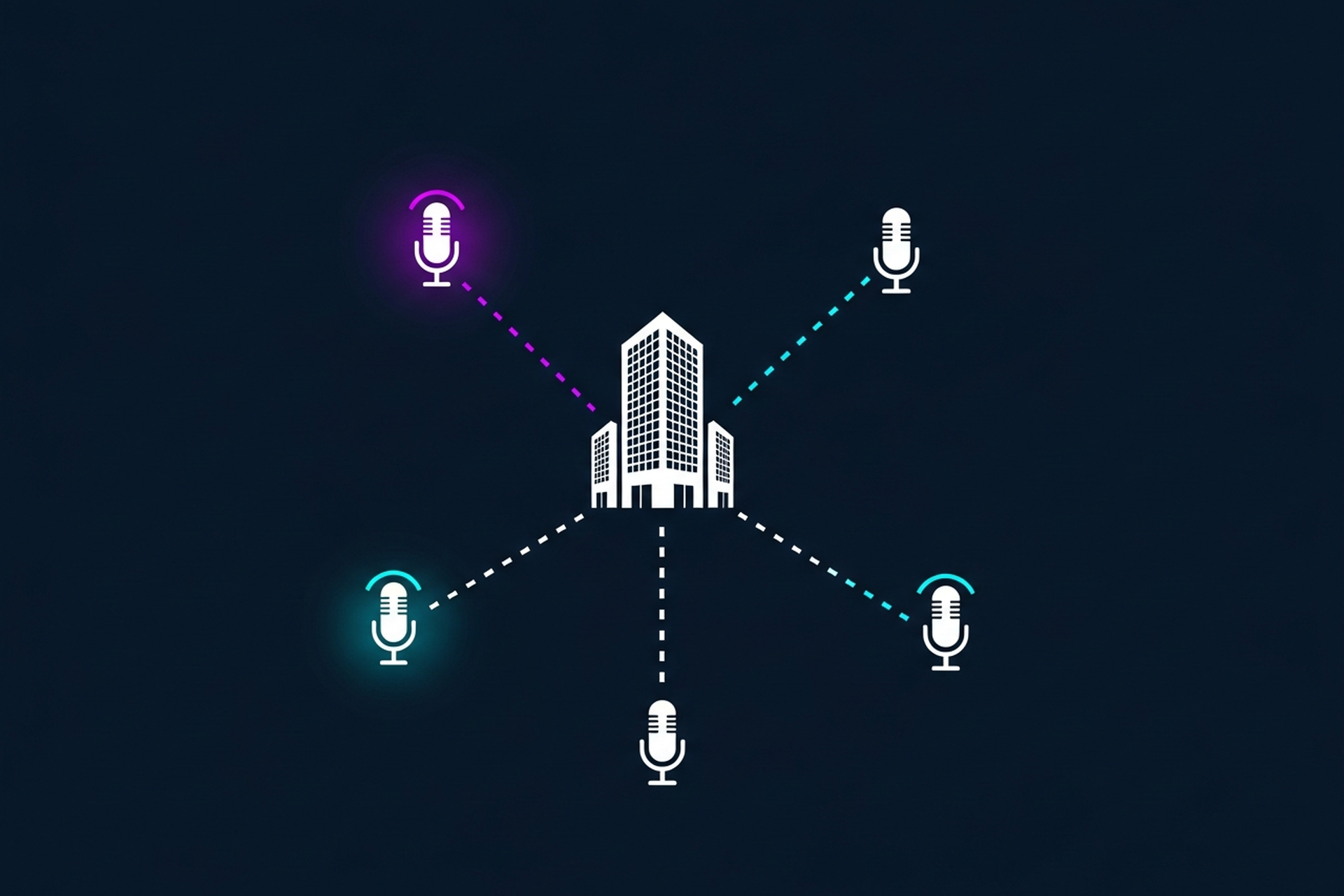
An internal company podcast is a private audio series produced for employees only. It's not published on Spotify or Apple Podcasts. It's hosted on a private RSS feed or gated platform, accessible only to people inside your organization.
Think of it as a company newsletter, but in audio form. Instead of reading a quarterly update in their inbox, employees pop in their earbuds during a commute or gym session and hear it from the CEO directly.
This is entirely distinct from the external B2B shows many companies launch to attract buyers and build thought leadership. Internal podcasts serve a completely different purpose: connecting teams, building culture, and delivering information efficiently across a distributed workforce.
Here's what's driving the trend:
Remote and hybrid work created a communication gap. When your team is spread across time zones, the "quick chat by the coffee machine" no longer exists. Information that used to flow naturally through an office now needs intentional delivery. Audio fills that gap in a way that email and Slack threads simply cannot.
Employees are overwhelmed by text-based content. The average knowledge worker sends and receives hundreds of messages per day. A well-produced five-minute audio update is easier to absorb than a three-paragraph Notion doc. Listening requires far less cognitive effort than reading.
Audio scales across seniority levels. A message from the CEO that's recorded once can reach 500 employees in 500 different cities at the same time. No scheduling, no calendar conflicts, no gaps in attendance.
Engagement with audio is high. Research on audio consumption habits in the workplace shows that people retain information from audio at significantly higher rates than text alone. That matters when the information is actually important, like safety updates, process changes, or strategic shifts.
The companies getting the most out of internal podcasts are usually running them in one of four ways. Most eventually run all four.

Onboarding is one of the highest-leverage places to invest in audio. Instead of handing new hires a 40-page PDF on company values and hoping they read it, you give them a short audio series they can listen to in their first week.
A well-built onboarding podcast can include:
This works particularly well for companies onboarding at volume. Once the audio is recorded, it costs nothing extra to onboard employee number 10 or employee number 1,000.
The all-hands meeting has a real problem: not everyone can make it, attention drops after 20 minutes, and the format is expensive to produce well. An executive update podcast solves all three issues.
Leaders record a 10 to 15 minute audio update covering what's happening in the business, what decisions are being made, and what priorities are shifting. Employees listen when it suits them. The message is consistent. No one misses it because of a conflicting meeting.
This is especially powerful for CEOs and senior leaders who want to communicate more personally without giving up calendar time every week.
Training is a natural fit for audio. Product knowledge updates, compliance walkthroughs, sales methodology refreshers, technical process guides: all of these can be delivered as a series of short audio episodes.
The advantage over video training is significant. Audio files are smaller, faster to produce, easier to update, and far more flexible for the listener. A sales rep can re-listen to a call methodology episode while driving to a meeting. A new hire can replay a benefits walkthrough on their commute. Video doesn't offer that kind of portability.
For companies running a podcast-based business communication strategy, internal training episodes can be part of a larger audio ecosystem that spans internal and external content.
This one is underrated. Internal storytelling podcasts, where employees share what they're working on, celebrate wins, or discuss what makes the company different, are genuinely effective at building belonging.
At companies where culture is a competitive advantage, an internal podcast becomes a living artifact. It captures the texture of what it feels like to work there, far better than a mission statement ever could.
Team spotlights, "behind the project" features, and quarterly "state of the team" conversations all make great episodes.
Getting started is simpler than most people expect. Here's what the process actually looks like.
Public podcast platforms like Spotify or Apple Podcasts are built for wide distribution. For internal use, you need a platform that supports private RSS feeds or password-protected access.
Popular choices include Spotify for Podcasters (which supports private shows), Transistor, and Buzzsprout. Some companies also use internal intranet tools or LMS platforms that accept RSS feeds. The key is that access is gated to your organization.
The most common mistake is trying to launch too many shows at once. Start with one format, one host or small host rotation, and a manageable cadence.
A weekly 10-minute leadership update or a monthly culture series are both realistic starting points. Consistency matters far more than frequency. Employees need to know when to expect new episodes and what value they'll get.
Internal podcasts don't need broadcast-quality production. But they do need to be clear, well-paced, and edited to remove the filler. A muddy recording or a meandering episode will kill engagement fast.
This is the step where many companies stumble. Getting the recording setup right, editing consistently, and publishing on schedule is harder than it looks, especially when it's not someone's primary job.
That's where working with a production partner makes sense. The done-for-you podcast production services from Podsicle Media cover everything from episode planning to final audio delivery, so internal teams don't have to figure it out from scratch.
Treat your internal podcast like any other internal communications program. Map out episode topics three to six months in advance. Align episodes with company milestones, product launches, or annual planning cycles.
A calendar keeps the show consistent and makes it easier to loop in guest contributors, like department heads or project leads, who need advance notice to prepare.
Completion rates are the most important metric for internal podcasts. If people are dropping off at the two-minute mark, the intro is too slow. If they're listening to the end every time, the format is working.
Most private podcast platforms provide per-episode play data and listener stats. Use that data to iterate: shorter episodes when completion rates drop, more frequent updates when engagement is high.
It's worth being direct about this because the two formats are often confused.
External podcasts are built for audience growth. They go on public directories, they're optimized for discovery, and their primary goal is reaching people who don't work for you: buyers, partners, prospects, and industry peers. If you want to build a podcast strategy for thought leadership, that's an external show.
Internal podcasts are built for operational clarity and employee engagement. They're not trying to reach new audiences. They're trying to reach the 200 or 2,000 people already inside your organization and give them better information than they'd get through email or a recorded Zoom call.
The strategy, tools, and success metrics are completely different. Many companies eventually run both. But they require separate planning, separate platforms, and separate production workflows.
Here's what the best internal shows have in common:
Internal podcasts are a smart investment. But they're only as valuable as the execution. Inconsistent publishing, poor audio quality, and episodes that drift without a clear agenda will cost you more in listener trust than they gain in efficiency.
Podsicle Media works with companies that want to do this right. From launching a company podcast from scratch to producing an ongoing series with full-service editing and delivery, the team handles the production side so your internal communicators can focus on the content.
Whether you're launching an executive update series, building a training library, or creating an onboarding audio program, the infrastructure exists to do it well.
Ready to launch your internal podcast? Get your free podcasting plan from Podsicle Media and find out what format fits your team.
Internal company podcasts are not a niche experiment anymore. In 2026, they're a legitimate communications strategy for any organization that wants to reach employees more effectively than email allows.
The use cases are clear: onboarding, leadership updates, training, and culture. The technology is accessible. The production barrier is lower than ever.
The companies moving fastest on this are the ones that started simple, stayed consistent, and built the habit. Start with one show, one format, one clear goal. The rest follows from there.