
Bad podcast editing is obvious. Abrupt cuts, inconsistent volume, background noise that pulses in and out, long stretches of dead air. Listeners notice all of it, even if they cannot articulate exactly what sounds off.
Good podcast editing is invisible. The conversation flows naturally, transitions are smooth, audio levels stay consistent, and every second of the episode earns its place. You do not notice it because there is nothing to notice.
For marketing directors running B2B branded podcasts, the editor is one of the most important production decisions you will make. They are the last line of quality control before your show reaches listeners, and their work directly shapes how your brand sounds to decision-makers.
This guide covers what great podcast editing actually looks like, how to evaluate editors during the hiring process, the human versus AI editing question, and what to expect at different price points.
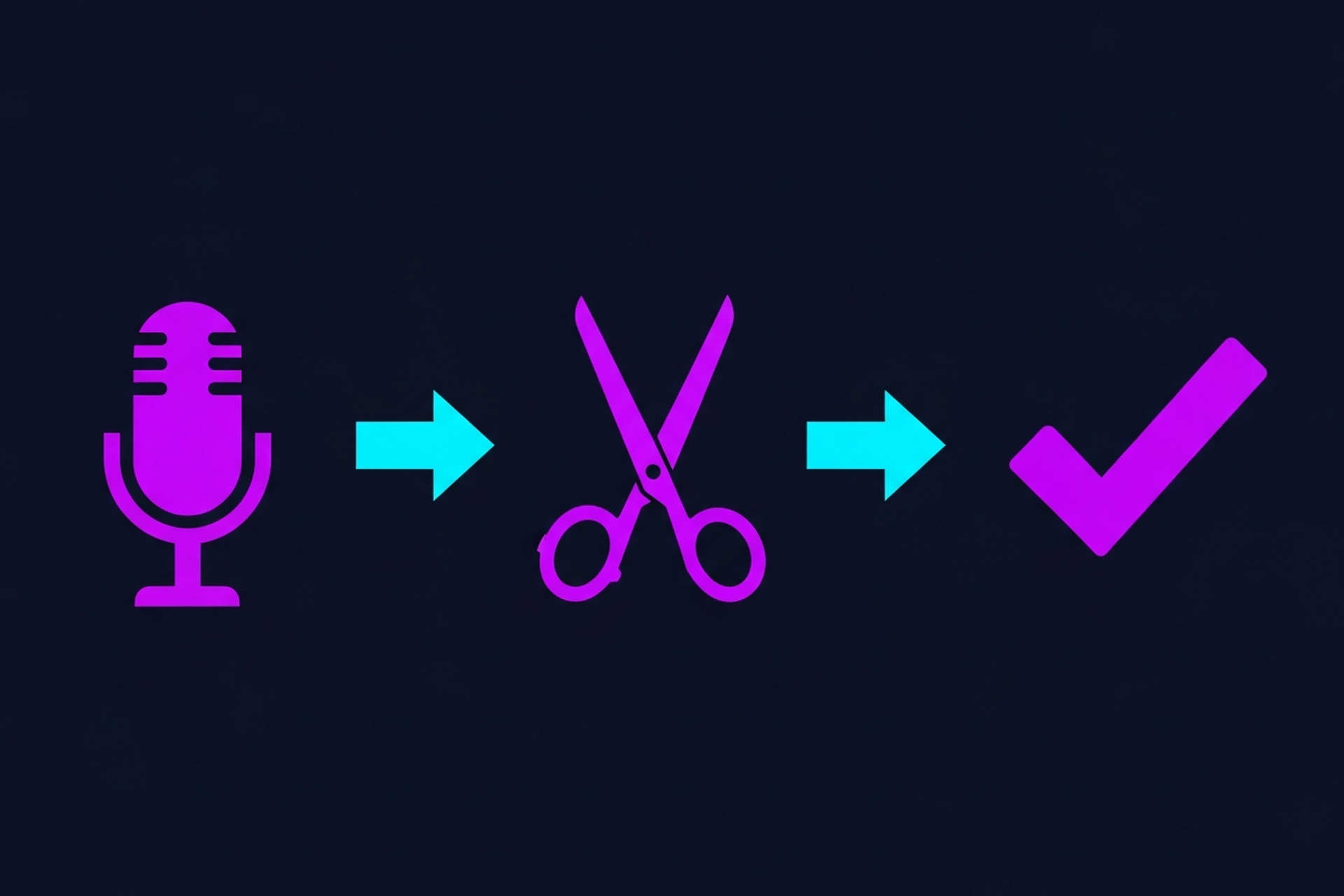
The job description varies by the scope you give them, but core podcast editing covers several distinct tasks.
Content editing. This is the structural work: removing filler words and verbal stumbles, cutting tangents that do not serve the audience, tightening long pauses, and making sure the episode flows logically from opening to close. Good content editing requires editorial judgment, not just technical skill. An editor who can only remove ums is not doing content editing.
Audio cleanup. Raw podcast audio almost always has issues: background noise from HVAC systems or traffic, keyboard clicks, chair squeaks, mic handling noise, and plosives (the popping sound on P and B sounds). Audio cleanup is the technical work of removing or reducing these issues without making the audio sound processed or unnatural.
Mixing and leveling. In a multi-speaker recording, each participant's volume needs to be normalized so the listener does not have to adjust their volume when speakers change. Music intro and outro levels need to be balanced against dialogue. This sounds simple but requires careful attention to get right.
Mastering. The final audio file needs to meet loudness standards for streaming platforms. Spotify, Apple Podcasts, and other platforms have target loudness levels, and a file that is too loud or too quiet will be adjusted automatically, often in ways that introduce distortion or reduce perceived quality.
Show notes and deliverables. Many podcast editors also produce show notes, timestamps, and transcript summaries as part of their workflow. This is often bundled with editing services and saves significant time for your team.
AI podcast editing tools have gotten significantly better in the past two years. Platforms like Descript and Adobe Podcast use AI to handle filler word removal, audio enhancement, and basic leveling automatically. For some use cases, these tools work well.
For B2B branded shows, the case for human editors remains strong, for a few reasons.
Content editing requires judgment. AI tools can remove filler words reliably. They cannot decide whether a particular tangent adds character to an interview or wastes four minutes of your listener's time. They cannot tell that a host hesitation actually signals an important moment worth keeping. Content editing is fundamentally an editorial task.
Brand voice consistency. A skilled human editor learns the rhythm of your show. They know which types of edits your hosts prefer, which verbal habits are signature style versus unintentional, and how to preserve the personality of the conversation while cleaning up the rough edges. AI tools do not build this kind of institutional knowledge.
Complex audio problems. Automated audio enhancement works well on standard background noise. It struggles with unusual recording conditions, overlapping speakers, recordings made in difficult acoustic environments, or audio that has specific problems requiring manual intervention.
The practical approach for most B2B teams: use AI tools to assist human editors rather than replace them. A human editor working with Descript's text-based interface and AI enhancement tools can produce quality output significantly faster than working manually, without the quality gaps of going fully automated.
The evaluation process should be concrete. Do not just ask for references and rates.
Ask for samples with interview content. Most podcast editors will show you their best work. Look specifically for samples that involve remote interviews, since that is the format most B2B shows use. Listen for whether cuts sound natural, whether volume stays consistent across speakers, and whether the conversation flows without obvious edits.
Ask how they handle audio problems. Give them a test scenario: you have an episode where one guest's audio has significant background noise and inconsistent volume. How do they approach it? A strong editor will walk you through their process specifically. A weak one will give vague reassurances.
Understand their turnaround time. Your editorial calendar depends on consistent delivery. Ask what their standard turnaround is from raw file receipt to finished episode, and what happens when they are sick or have a conflict. Solo freelancers carry more risk than editors with backup support.
Clarify deliverables in writing. What is included in the edit? Raw audio processing only? Full mix and master? Show notes? Timestamps? Transcript? Make sure your expectations and their standard scope are aligned before signing anything.
Ask about their capacity. An editor who is fully booked and fitting you in at the margins is not giving you their best work. Ask how many shows they currently produce per month and whether they have capacity to absorb yours without compressing their workflow.
Several channels work well for finding qualified podcast editors.
Production agencies. Agencies that offer podcast production services typically have editors on staff or in their contractor network. If you hire through an agency, you get a layer of quality control and redundancy that you do not get with a freelancer.
Podcast editing platforms. Services like Resonate Recordings and Podcast Buddy offer editing as a service with standardized workflows and pricing. These are worth evaluating if you want predictable costs and reliable turnaround without managing a freelancer relationship.
Freelancer marketplaces. Upwork and specialized audio communities like Podcast Movement's Facebook groups surface qualified freelancers. Vetting is more work on your end, but rates can be significantly lower than agency pricing.
Referrals. The most reliable source. Ask other B2B marketing directors or content leads who produces shows you admire. A referral from someone in a similar situation carries more signal than any portfolio.
Pricing varies widely based on episode length, complexity, what is included, and whether you are working with a freelancer or an agency.
Freelance editors typically charge per finished minute of audio, ranging from $0.75 to $3.00 per finished minute depending on experience and deliverables. For a 45-minute episode with full editing, cleanup, mixing, and show notes, expect to pay between $75 and $200 on the lower end and $150 to $400 on the higher end.
Agency editing, bundled into a broader production package, typically runs $300 to $800 per episode at the mid-market level, with premium B2B production agencies charging more for strategic services and full repurposing.
The mistake B2B teams make most often is optimizing for the lowest editing rate and then discovering that the overall production cost is higher once they account for the time spent managing quality issues, requesting revisions, and compensating for things the low-cost editor did not include.
Several AI podcast editing tools have earned genuine credibility for parts of the editing workflow.
Descript. Text-based editing with AI filler word removal, Overdub for small corrections, and reasonable audio enhancement. Strong for teams doing their own editing or working with editors who prefer a modern interface.
Adobe Podcast (now Adobe Enhance). Excellent audio enhancement tool, particularly for cleaning up recordings made in less-than-ideal conditions. Useful as a preprocessing step before full editing. Free tier is available.
Auphonic. Automated leveling, noise reduction, and loudness normalization. Works well as a finishing step for files that have already been manually edited. Reliable and affordable.
Podcastle. Recording and editing platform with AI-powered cleanup. Reasonable for lightweight production needs.
These tools work best when integrated into a human-driven workflow rather than as standalone replacements for editorial judgment.
For B2B shows with a full production team, the editor is one part of a broader workflow. They receive files from the recording session, work within a brief or style guide prepared by the producer, and return finished files for distribution and repurposing.
When this relationship works well, it is mostly invisible. The editor understands the show's standards, asks questions proactively rather than making assumptions, and delivers consistently on time. The producer or marketing lead is reviewing final files, not problem-solving audio issues or chasing turnaround deadlines.
When it does not work, it creates drag across the entire production pipeline. Late edits push distribution. Quality inconsistencies require re-review. Communication gaps lead to corrections that eat time.
Building a clear, documented brief for your editor is the best investment you can make early in the relationship. Include: show format, target episode length, editorial style preferences, audio standards, deliverables per episode, and turnaround expectations. The brief makes the quality expectations explicit and gives you a reference point when things need to be corrected.
For teams thinking through the full editing stack, see free audio processing software for an overview of the tools that support the editing process, and best voice editing software for a closer look at voice-specific editing tools.
The signal that you have outgrown your current editing setup is usually one of three things: your editor is becoming a bottleneck (turnaround is slipping), quality is inconsistent across episodes, or your repurposing workflow is not connected to your editing output.
At that point, a more structured production arrangement makes sense. An agency or production partner who manages the editor relationship and owns quality control removes that management burden from your team. You get consistent output with a single point of accountability.
If you are at the point where your podcast feels like it needs a real production infrastructure, Podsicle Media offers full-service B2B podcast production with editing, distribution, and content repurposing built in. Let us know what you are building and we can walk you through how it works.